
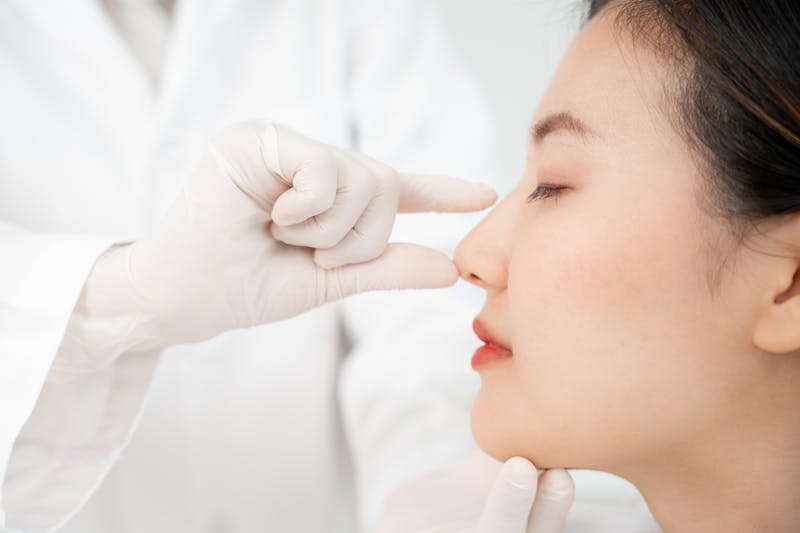
The safety of a liquid nose job depends almost entirely on one variable: the expertise of the person performing it. Liquid rhinoplasty uses injectable hyaluronic acid fillers to reshape nasal contours without surgery or recovery time, and the procedure itself is well tolerated. The nose's proximity to the ophthalmic vascular system, however, means that technique and material selection carry weight they simply don't in most other facial filler work.
Dr. Deepak Dugar, MD, double board-certified rhinoplasty surgeon and founder of Beverly Hills Rhinoplasty Center, applies the same standard of honest assessment to every non-surgical consultation that defines his surgical practice. Read on for a direct look at what liquid rhinoplasty can realistically accomplish and where the risks lie.
What Liquid Rhinoplasty Can and Can't Do
A non-surgical nose job uses HA filler injections to add volume and reshape contours, leaving bone and cartilage completely untouched. Results are immediate and temporary, lasting roughly 9 to 18 months, depending on the product and the patient's metabolism. The procedure is appropriate for a specific set of concerns:
- Smoothing a dorsal hump: Filler placed above and below a visible bump creates the visual impression of a straighter profile.
- Refining the nasal tip: Filler can subtly lift or define the tip without cartilage removal.
- Correcting minor asymmetries: Small additions to one side can bring the nose into better visual balance.
- Improving facial proportion: When the nose sits slightly out of harmony with surrounding features, well-placed filler can restore a more harmonious proportion.
Filler adds volume. It cannot reduce the size of the nose, correct a deviated septum, improve airflow, or deliver a permanent result. Patients seeking any of those outcomes belong in a surgical consultation, and Dr. Dugar makes that clear in every non-surgical assessment he conducts.
The Risks Are Real and Specific
The most serious risk associated with nasal filler is vascular occlusion: filler entering or compressing a vessel, cutting off the blood supply to surrounding tissue. Left untreated, the result can be skin necrosis. In more extreme cases, filler can migrate into vessels connected to the ophthalmic artery, with potential for permanent vision loss or stroke.
These events are rare, but they are not theoretical. Any provider who frames nasal filler as entirely risk-free is either unfamiliar with the complication literature or choosing to obscure what patients deserve to know. The nose's proximity to the ophthalmic vascular system requires anatomical expertise that a general aesthetics background doesn't guarantee.
How Safe Technique Is Built
Hyaluronic acid fillers are the appropriate choice for nasal treatment. If a complication arises, hyaluronidase can dissolve HA filler on demand. Non-HA products offer no such reversal, which is why they have no place in nasal injections.
Beyond material selection, each technical decision compounds the safety of the overall procedure. The Beverly Hills Rhinoplasty Center protocol uses micro-aliquot injections at low pressure, with frequent aspiration checks to confirm no vessel contact. In certain zones, cannula delivery further reduces the risk of inadvertent vessel penetration. Hyaluronidase is kept on hand during every treatment. These choices define the standard of care extended to every patient who enters the atelier.
Schedule a Consultation with Dr. Deepak Dugar, MD
Certified by the American Board of Otolaryngology, Head and Neck Surgery and the American Board of Facial Plastic and Reconstructive Surgery, Dr. Dugar has the anatomical training and clinical discipline that nasal filler treatment demands. To find out whether liquid rhinoplasty is appropriate for your goals, schedule a consultation at Beverly Hills Rhinoplasty Center.